
 Continue with Google
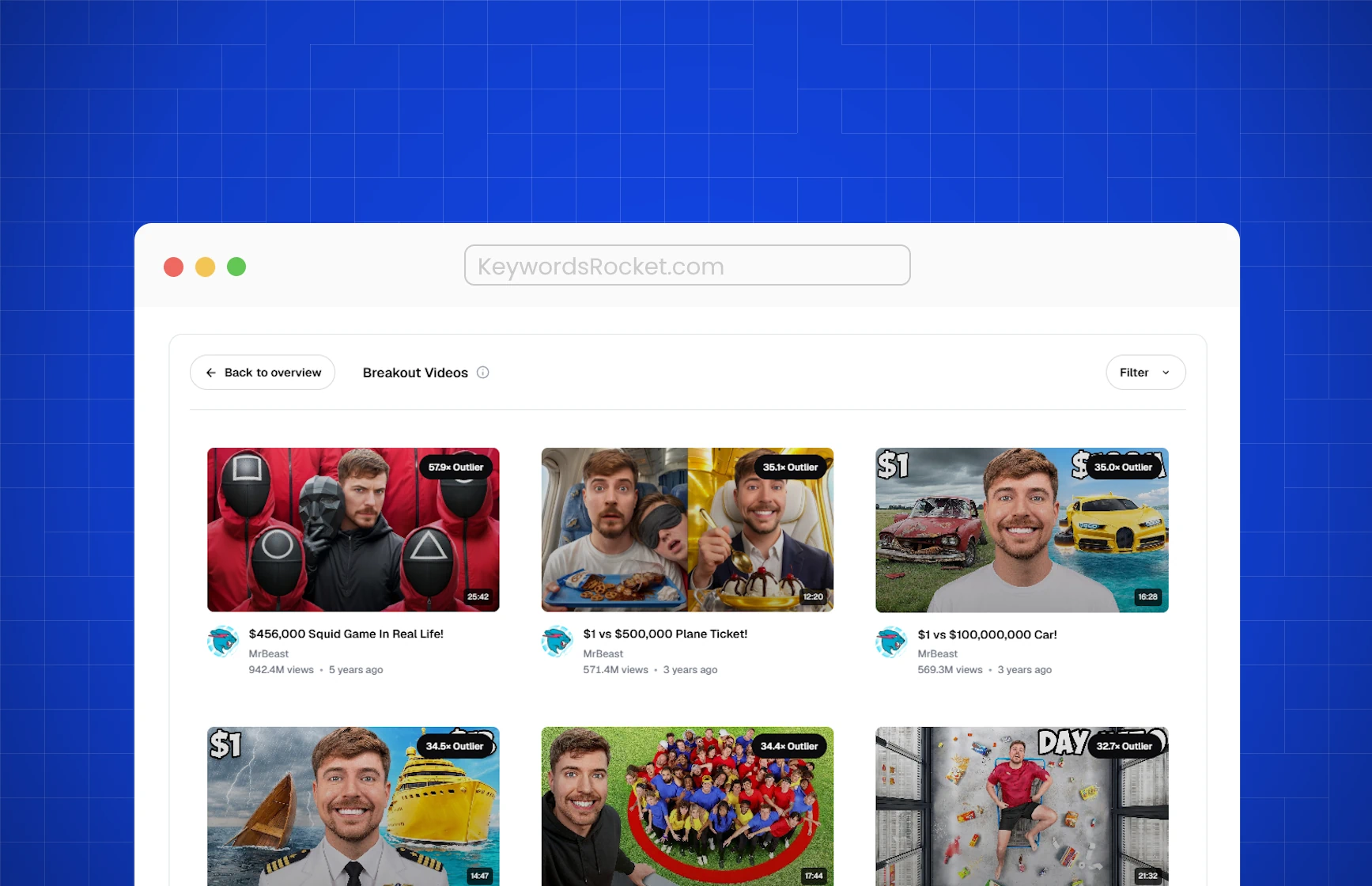
To find YouTube outlier videos, compare each upload with the recent typical performance of its own channel. Start with comparable videos, use the median as a baseline, adjust your judgment for age and view velocity, then investigate why the strongest videos broke away. The useful outliers are not simply the biggest videos. They reveal an audience demand, format, or promise that may be transferable to an original idea.
That final word matters. One viral upload can be a celebrity spike, a news event, an old video that accumulated views for years, or a result of traffic you cannot see from public data. This guide separates repeatable evidence from tempting noise.
What counts as a YouTube outlier?
An outlier video performs materially above a useful baseline for the channel that published it. If a channel's comparable recent uploads normally receive 20,000 views and one reaches 140,000 in a similar period, the 140,000-view upload deserves attention. A 140,000-view video on a channel that routinely receives 300,000 does not.
This is why absolute view count is a poor starting point. It favors large channels and hides unusually successful work from smaller creators. Subscriber count is also incomplete. YouTube notes that subscribers can become inactive and that subscriber-feed behavior often shows viewers skipping many uploads. A channel's recent video performance is usually a more useful public baseline than its lifetime subscriber total.
The simplest outlier multiplier is:
Video views ÷ median views of comparable recent uploads
If the median of ten comparable uploads is 18,000 views and the target video has 126,000, the simple multiplier is 7x. This calculation is a screening tool, not a prediction. Publishing age, format, topic, and traffic timing still need review.
Use the median, not the average, for the first pass. One previous hit can pull the average upward and make the channel's normal performance look stronger than it is. The median is less distorted by a small number of extreme videos.
How to find outlier videos manually
1. Build a relevant channel set
Begin with channels that compete for the same viewer, not merely channels that share a broad category. A personal-finance channel for university students and an institutional market-news channel both discuss money, but their audiences, formats, and promises differ. Copying signals between them produces weak conclusions.
Create a small set of direct competitors, adjacent channels, and emerging specialists:
- Direct competitors serve a similar audience with similar subjects.
- Adjacent channels serve the same audience from a different angle.
- Emerging channels are smaller or newer creators whose recent breakouts may expose changing demand.
Five well-matched channels are more useful than fifty loosely related ones. If you are still defining the market, a YouTube niche analysis can help identify the topic boundaries before you collect competitors.
2. Separate videos that should not share a baseline
Do not mix long-form videos, Shorts, live streams, trailers, and community announcements into one calculation. Their discovery surfaces, viewer expectations, and performance curves differ. YouTube's own creator guidance recommends comparing videos of the same format because audience behavior varies across formats.
Also separate obvious exceptions when they answer a different demand. A software tutorial, a founder interview, and a breaking-news reaction can live on the same channel while following different performance patterns. The purpose is not to remove every unusual video. It is to avoid calling a format change an outlier before you understand the format.
3. Calculate a recent channel baseline
Collect the view counts for roughly ten recent comparable uploads, excluding the candidate video. Sort the values and take the median. Ten is a practical review window, not a universal rule. Use a larger set when the channel uploads frequently and the topic is stable. Use a smaller but carefully matched set when formats have changed.
| Illustrative upload | Views after a comparable period | Use in baseline? |
|---|---|---|
| Standard tutorial 1 | 14,000 | Yes |
| Standard tutorial 2 | 17,000 | Yes |
| Standard tutorial 3 | 18,000 | Yes |
| Standard tutorial 4 | 21,000 | Yes |
| Standard tutorial 5 | 25,000 | Yes |
| Livestream replay | 6,000 | No, different format |
| Candidate breakout | 126,000 | No, compare against baseline |
In this simplified example, the median of the five standard tutorials is 18,000. The candidate is a 7x outlier against that baseline. All figures are illustrative. They do not represent a universal threshold or a real channel.
4. Compare videos at a similar age
A video published three years ago has had more time to accumulate search and suggested traffic than a video published last month. Total views alone can therefore exaggerate older evergreen content. Check how quickly the video appears to be gaining views and compare uploads at similar ages when possible.
Public data cannot reveal every historical traffic pattern. A research tool can estimate velocity from observable data, but only the channel owner can see the complete traffic-source history in YouTube Studio. Treat public velocity as directional evidence.
5. Repeat the scan across multiple channels
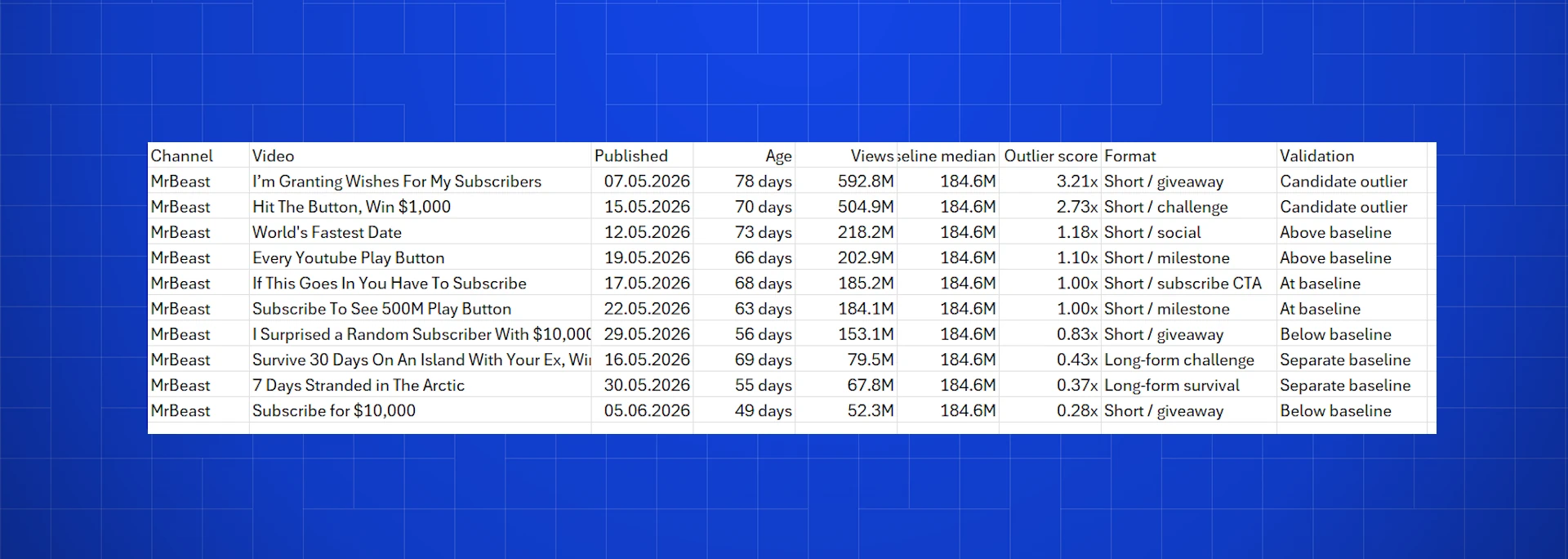
One outlier is a lead. Several related outliers are a pattern. Search for the same audience problem, promise, or format on other relevant channels. The titles do not need to use identical wording. You are looking for repeated demand beneath the packaging.
Suppose three smaller channels each break their normal baseline with videos that compare cheap and expensive versions of the same tool. The transferable pattern may be a decision format with a clear cost tradeoff. It is not the exact product, title, or thumbnail used by one creator.
Seven outliers that can mislead you
A high multiplier tells you where to investigate. It does not tell you why the video worked or whether the idea will transfer. Reject or heavily discount these common false positives.
1. The old evergreen accumulator
An older video may have collected search views for years while the comparison set is recent. It can still reveal durable demand, but its total-view multiplier overstates the current opportunity. Compare its continuing velocity and inspect whether fresher videos on the same subject also perform.
2. The breaking-news spike
A policy change, product launch, controversy, or public event can create demand that disappears before your video is ready. Check the publication date and determine whether the idea depends on a narrow moment. A repeatable news format is different from copying one expired story.
3. The famous guest or collaboration
A notable guest can bring an audience that the channel does not normally reach. The video's topic and packaging may be strong, but the distribution advantage may be impossible to reproduce. Ask whether the idea works without the name in the title or face in the thumbnail.
4. The external-traffic event
A newsletter, website, social post, course, or press mention can create a public view spike with no visible explanation. Competitor research cannot see private traffic-source reports. If the multiplier has no supporting pattern and the topic does not appear unusually strong elsewhere, lower your confidence.
5. The format mismatch
A Short with millions of views is not a clean benchmark for a 20-minute tutorial. A livestream replay is not a clean benchmark for an edited documentary. Keep the signal within the format you can realistically produce.
6. The channel-pivot effect
A breakout can indicate that the channel has found a better audience, but the old uploads then become an outdated baseline. Review what happened next. If several following videos use the new direction and remain stronger, you may be seeing a successful pivot rather than a single outlier.
7. The unrepeatable spectacle
Some videos win because the creator spent unusual money, gained exclusive access, accepted a major risk, or documented a once-only event. The concept may be impressive and useless for your production reality. Transferability includes budget, access, skill, and credibility.
The four checks that make an outlier worth using
Once the false positives are removed, evaluate each candidate across four questions. This is the point where outlier research becomes content strategy.
| Check | Question | Strong evidence | Warning sign |
|---|---|---|---|
| Demand | Did the audience want the underlying problem or promise? | Related outliers appear across relevant channels | Only one unexplained spike exists |
| Transferability | Can the winning mechanism work without copying? | The format or decision can be adapted to another case | Success depends on a guest, event, or exclusive access |
| Channel fit | Will your current or intended viewers care? | The idea is adjacent to proven audience interests | The topic attracts a separate audience with no follow-up path |
| Repeatability | Can one insight support a useful series? | Several distinct follow-ups solve the same type of problem | The idea exhausts itself after one upload |
Demand: identify the viewer's job
Reduce the video to the job it performs. Does it help viewers choose, fix, understand, avoid, compare, or experience something? A title is packaging. The job beneath it is the transferable demand.
Keyword research can strengthen this check when the topic has search intent. Use the YouTube Keyword Tool to inspect related phrasing, estimated demand, questions, and competition. Outliers can reveal recommendation-led ideas as well, so the absence of a large search estimate does not automatically invalidate a concept.
Transferability: extract the mechanism, not the surface
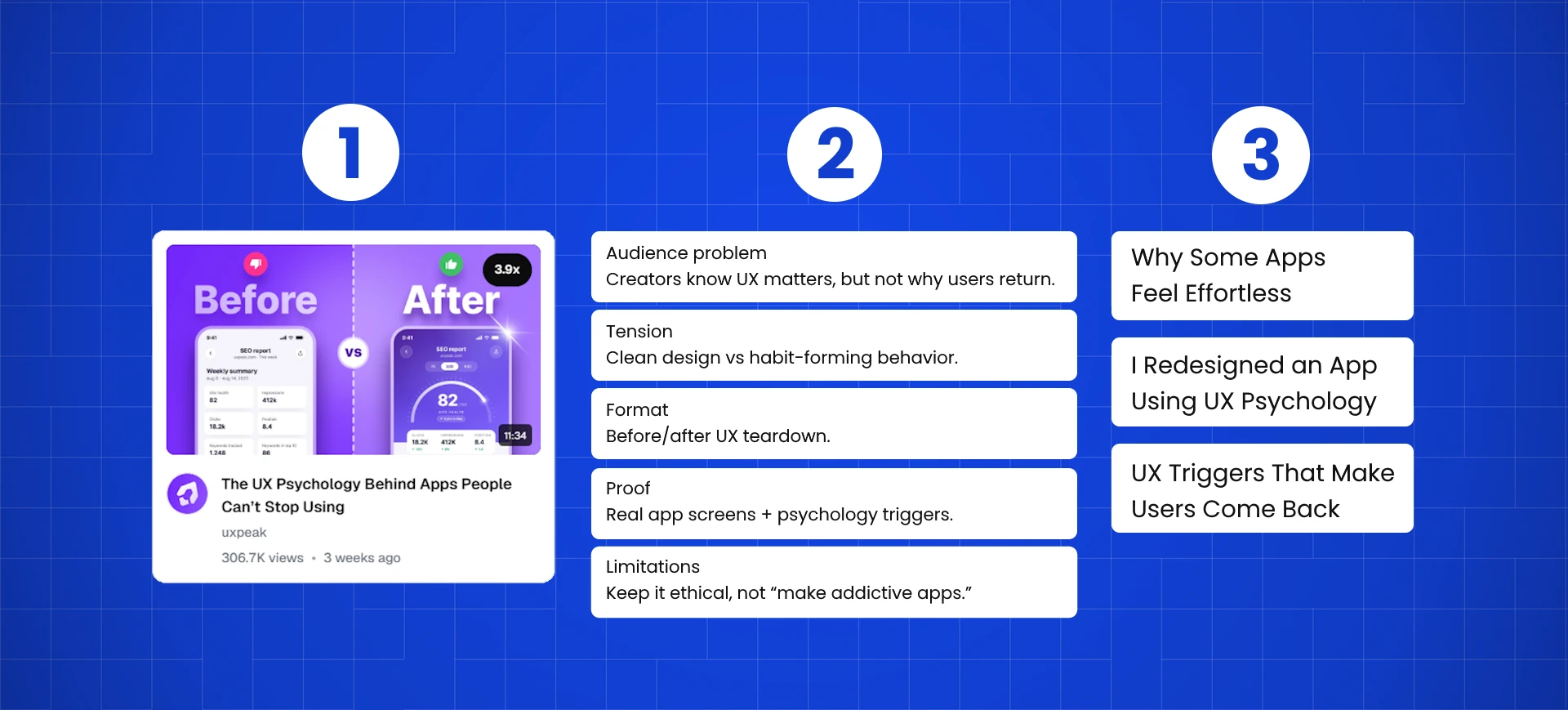
Break the outlier into components:
- Audience: Who immediately understands the promise?
- Tension: What decision, risk, surprise, or curiosity drives the click?
- Format: Is it a test, comparison, challenge, teardown, case study, or tutorial?
- Proof: What makes the outcome credible?
- Timing: Why was the subject relevant when published?
Your new idea should preserve a useful mechanism while changing the case, evidence, audience contribution, and packaging. Replacing one noun in a title is imitation, not research.
Channel fit: protect the next view
A topic can generate a successful video and still weaken the channel if the viewers have no reason to watch what comes next. Before producing it, list three existing or planned videos that the same viewer would plausibly choose afterward. If that is difficult, the outlier may sit outside your channel's useful boundary.
For established channels, verify fit with your own data. YouTube Analytics Advanced Mode can compare videos, groups, and time periods. YouTube also recommends grouping similar videos and comparing watch-time performance when looking for content patterns.
Repeatability: require more than one lucky example
A strong pattern can generate several genuinely different videos. A weak pattern produces near-duplicates. Sketch three follow-ups before approving the first idea. Each should solve a distinct problem while using the same underlying format or audience tension.
A useful rule: do not build a strategy around one outlier. Build a test around one outlier, then use the result to decide whether the pattern deserves a series.
Worked example: from 8x outlier to original idea
Imagine a channel that reviews productivity apps. Its recent comparison videos have a median of 12,000 views after 60 days. One video, “I Replaced Five Apps With One Workspace,” reaches 96,000 views in the same period, making it an illustrative 8x outlier.
Copying the title with another app would be the shallow response. A better review asks why the promise worked:
- The viewer faces subscription fatigue and tool overload.
- The video promises a concrete reduction, not another feature tour.
- The creator runs a visible before-and-after test.
- The outcome affects both cost and daily friction.
The transferable mechanism is a consolidation test with measurable tradeoffs. An original follow-up could compare whether one specialized tool is worth keeping after a broader workspace replaces the rest. The creator can use a different setup, disclose the test criteria, and show where consolidation fails. That adds a decision the first video did not answer.
Before production, the creator should look for similar breakouts across adjacent software channels, check whether viewers search for the relevant app combinations, and confirm that the channel has follow-up topics around cost, workflow, or migration. The outlier supplies evidence for a test, not permission to duplicate a winner.
How outlier tools help, and where they stop
Manual research is possible, but it becomes slow when you repeat the calculation across dozens of channels. Current outlier products commonly automate discovery in different ways. TubeLab describes a library that scans for high-performing videos, vidIQ provides outlier tabs for videos, Shorts, channels, and thumbnails, OutlierKit lets users sort videos beating their channel average, and Viewstats offers an Outliers tool for finding videos performing well around an idea, trend, or niche.
KeywordsRocket's YouTube Outlier Finder searches by topic, niche, or competitor and surfaces uploads breaking their channel baseline. The current product combines performance lift with signals such as view velocity, total reach, publishing age, and channel size. Filters help narrow the result set, and a video breakdown can support closer inspection of the topic, title, SEO signals, and structure.
The tool cannot see a competitor's private retention graph, traffic-source history, revenue, or production constraints. No public outlier score can tell you whether the result came from external distribution or whether your audience will respond the same way. Use automation to find candidates faster, then apply the demand, transferability, channel-fit, and repeatability checks yourself.
| Task | Manual method | Outlier finder |
|---|---|---|
| Discover relevant channels | Search topics and follow recommendations | Search a topic, niche, or competitor |
| Estimate channel baseline | Record comparable uploads and calculate a median | Automatically compare videos with channel performance |
| Account for recency | Record upload dates and compare similar ages | Use age and velocity signals in the result set |
| Explain the breakout | Inspect the video, packaging, comments, and related results | Open the candidate and review supporting signals |
| Validate fit for your channel | Use your strategy and private Studio data | Requires creator judgment |
Use your own channel to confirm the pattern
Competitor outliers suggest what to test. Your channel data tells you what your viewers actually rewarded. After publishing a test, compare it with a group of similar videos in YouTube Analytics rather than judging only the total view count.
Review at least these questions:
- Which traffic sources created the views: browse, suggested, search, external, or another source?
- Did the title and thumbnail earn impressions and clicks from the intended audience?
- Did viewers stay after the opening promise?
- Did the video lead viewers toward another relevant upload?
- Does the same format perform again when the subject changes?
YouTube's Advanced Mode supports comparisons between videos, groups, and time periods. Groups can contain up to 500 of your videos, which makes them useful for comparing a format or topic cluster over time. Keep Shorts and long-form tests separate.
If one test succeeds, publish a distinct second example. If the second and third attempts remain above the relevant baseline, the outlier research has started to reveal a repeatable format. If performance collapses, revisit whether the first result depended on timing, packaging, or an audience that did not return.
The final outlier checklist
Before an outlier becomes a production brief, confirm all of the following:
- The video beats a recent, format-matched channel baseline.
- Its performance is strong for its age, not only in lifetime views.
- The result is not explained mainly by a famous guest, expired event, or format mismatch.
- Related evidence appears on at least one other relevant channel or topic.
- You can explain the viewer's underlying job in one sentence.
- Your version contributes different evidence, access, experience, or a new decision.
- The idea fits viewers you want to retain.
- You can name three plausible follow-ups without creating duplicates.
- The production requirements fit your budget, skills, and access.
- You will judge the test against the right group in your own Analytics.
An outlier is most useful as evidence that a particular audience response happened under particular conditions. The research advantage comes from understanding those conditions better than the creator who merely copies the title.
Find the videos breaking their channel baseline
Search a topic, niche, or competitor, then inspect the outliers that deserve a closer content decision.
Find YouTube outliersFrequently asked questions
What is an outlier video on YouTube?
A YouTube outlier is a video that performs materially better than a useful baseline for its own channel. A sound comparison accounts for publishing age, format, and the channel's recent typical performance.
How do you calculate a YouTube outlier score?
A simple starting point is to divide the video's views by the median views of comparable recent uploads from the same channel. A more useful system can also consider view velocity, publishing age, channel size, and total reach. There is no single official YouTube outlier formula.
Can I find YouTube outliers manually?
Yes. Review recent uploads, separate comparable formats, calculate the median view count, and compare each candidate with that baseline. Repeat the process across several channels that serve the same viewer.
Should I copy an outlier video's title or thumbnail?
No. Extract the audience problem, promise, format, proof, and timing that may have worked. Your video should make a distinct contribution and use original packaging.
What is a good outlier multiplier?
There is no universal cutoff. A 3x result may be meaningful on a stable channel with tightly grouped performance, while a volatile channel may need a larger difference. Treat the multiplier as a ranking signal and inspect the context.
Does an outlier guarantee that the topic will work again?
No. A spike can result from timing, external traffic, novelty, a notable guest, or chance. Look for repeated evidence across related videos and channels, then test the pattern with an original idea.
Sources checked
Product descriptions and YouTube Analytics guidance were checked on July 24, 2026:
- YouTube Help: Learn how to use Advanced Mode for analytics reports
- YouTube Help: Get analytics for playlists and groups of videos
- YouTube Help: Tips to learn what viewers are watching
- YouTube Help: Good to know about recommendations
- vidIQ Help: Outliers
- Viewstats Support: Outliers Tool
- TubeLab: YouTube Outliers Finder
- OutlierKit: Outlier research
- Let's Play Index: MrBeast video statistics
Editorial note: The example baselines and multipliers in this article are illustrative. YouTube does not publish an official universal outlier threshold.