
 Continue with Google
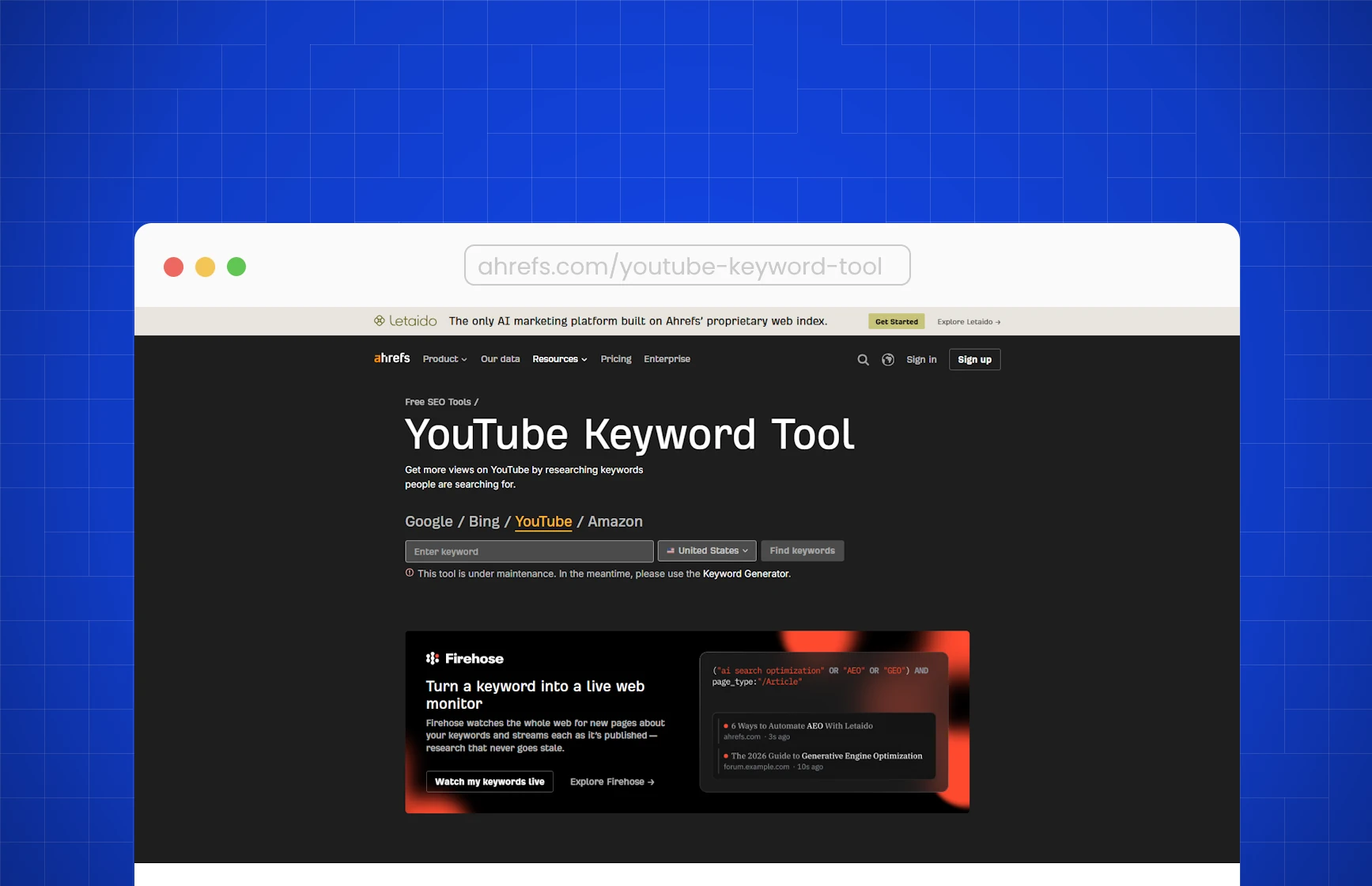
Ahrefs does have a working YouTube Keyword Tool in 2026. It can generate keyword ideas for YouTube, estimate monthly search demand by country, and help creators move beyond autocomplete guesses. For a quick check, especially if you already trust Ahrefs for SEO research, it is genuinely useful.
Its limitation is scope. A keyword list can tell you that people search for a phrase, but it does not show whether the current YouTube results are dominated by giant channels, whether smaller creators are breaking through, which competing videos are true outliers, or whether the topic fits a repeatable channel strategy. Those questions require YouTube-native evidence around the keyword.
This review separates the free Ahrefs tool from the broader Keywords Explorer workflow, explains how to interpret the data, and compares it with KeywordsRocket's YouTube keyword research. The goal is a practical decision: when Ahrefs is enough, when it is incomplete, and what to check before you commit to a video.
The short verdict
Use Ahrefs when you need a fast list of YouTube queries and a directional estimate of demand. It is especially sensible for SEO professionals who already work inside Ahrefs or creators who only need occasional keyword validation.
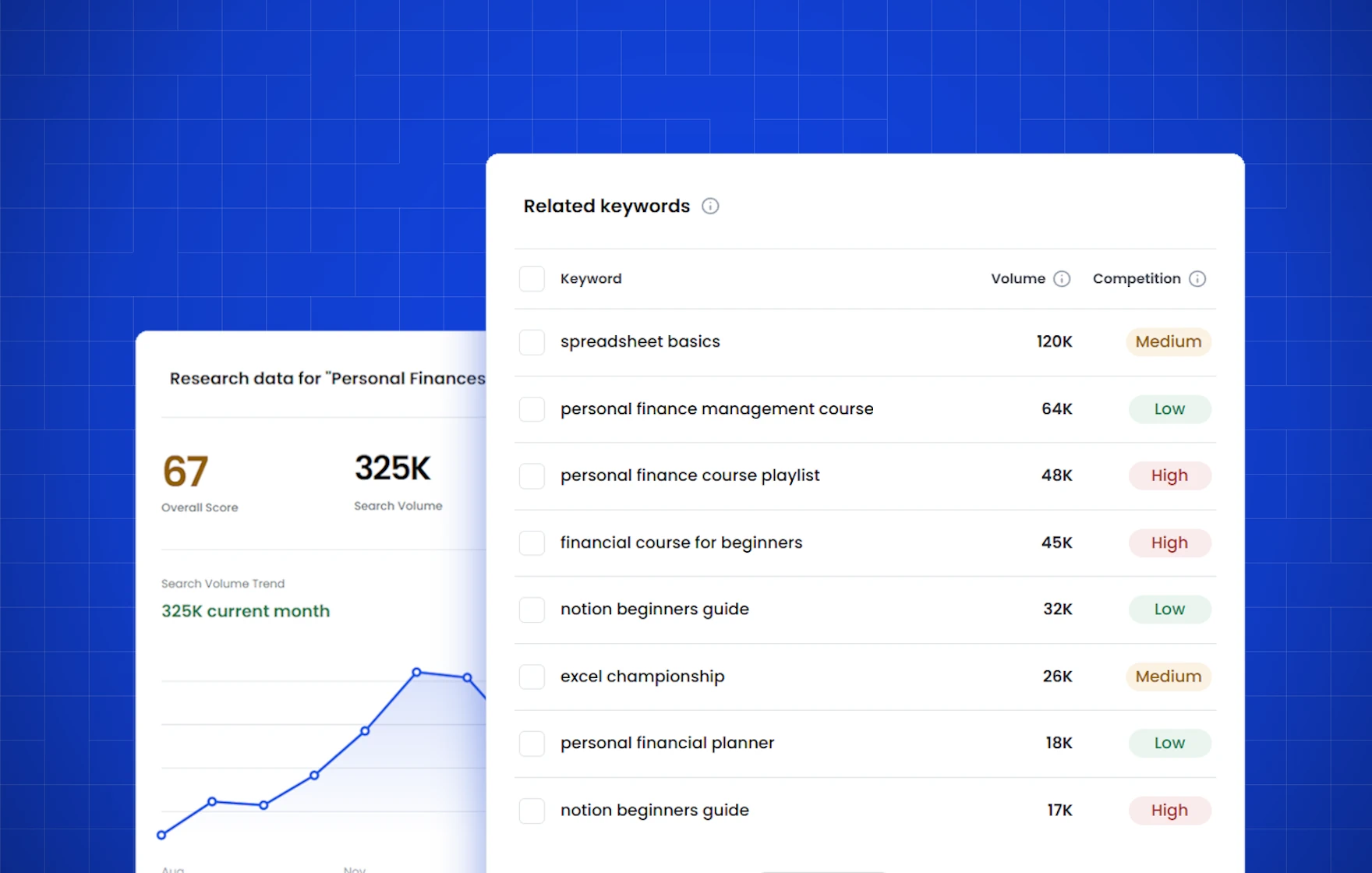
Use a YouTube-native research platform when your decision depends on competition, channel fit, current videos, niches, competitors, or breakout formats. KeywordsRocket expands a topic into matching terms, related keywords, and viewer questions, then connects those queries to estimated demand and competition. Its other research areas let you continue from the keyword into niche, channel, competitor, and outlier analysis.
| Research question | Ahrefs YouTube Tool | KeywordsRocket |
|---|---|---|
| What related queries exist? | Yes, through the free generator and deeper idea reports | Yes, with matching terms, related keywords, and viewer questions |
| How much demand might the query have? | Monthly search-volume estimate | Estimated YouTube search volume and trend signals |
| How competitive are the current YouTube results? | Not the main purpose of the free YouTube generator | Competition estimate based on the strength and distribution of current results |
| Which channels and formats are winning? | Requires separate research outside the keyword generator | Channel, competitor, niche, and outlier workflows |
| Can I export or organize findings? | Lists and exports in the broader Ahrefs workflow | Copy and export selected keywords to CSV, JSON, or text |
| Best fit | Quick keyword expansion and existing Ahrefs users | Creators making a full YouTube topic decision |
What the Ahrefs YouTube Keyword Tool actually does
Ahrefs maintains a dedicated public page for YouTube keyword research. Enter a broad topic, choose a country, and the tool returns related ideas with estimated monthly search volume. Ahrefs says the country coverage spans more than 170 locations and that its volume estimates are built by processing clickstream data.
The free interface is designed for speed. It is useful when you have one seed topic and want to answer three basic questions:
- Do people appear to search for this topic on YouTube?
- Which adjacent phrases and question-based variants should I inspect?
- Does one wording appear to have materially more demand than another?
Ahrefs also describes a deeper route through Keywords Explorer. That workflow can generate larger sets of ideas, expose phrase-match reports, and save selected keywords in lists. The distinction matters because many reviews blend the free generator and the paid platform into one product. A creator testing the free page should not assume every advanced report or organizational feature is included there.
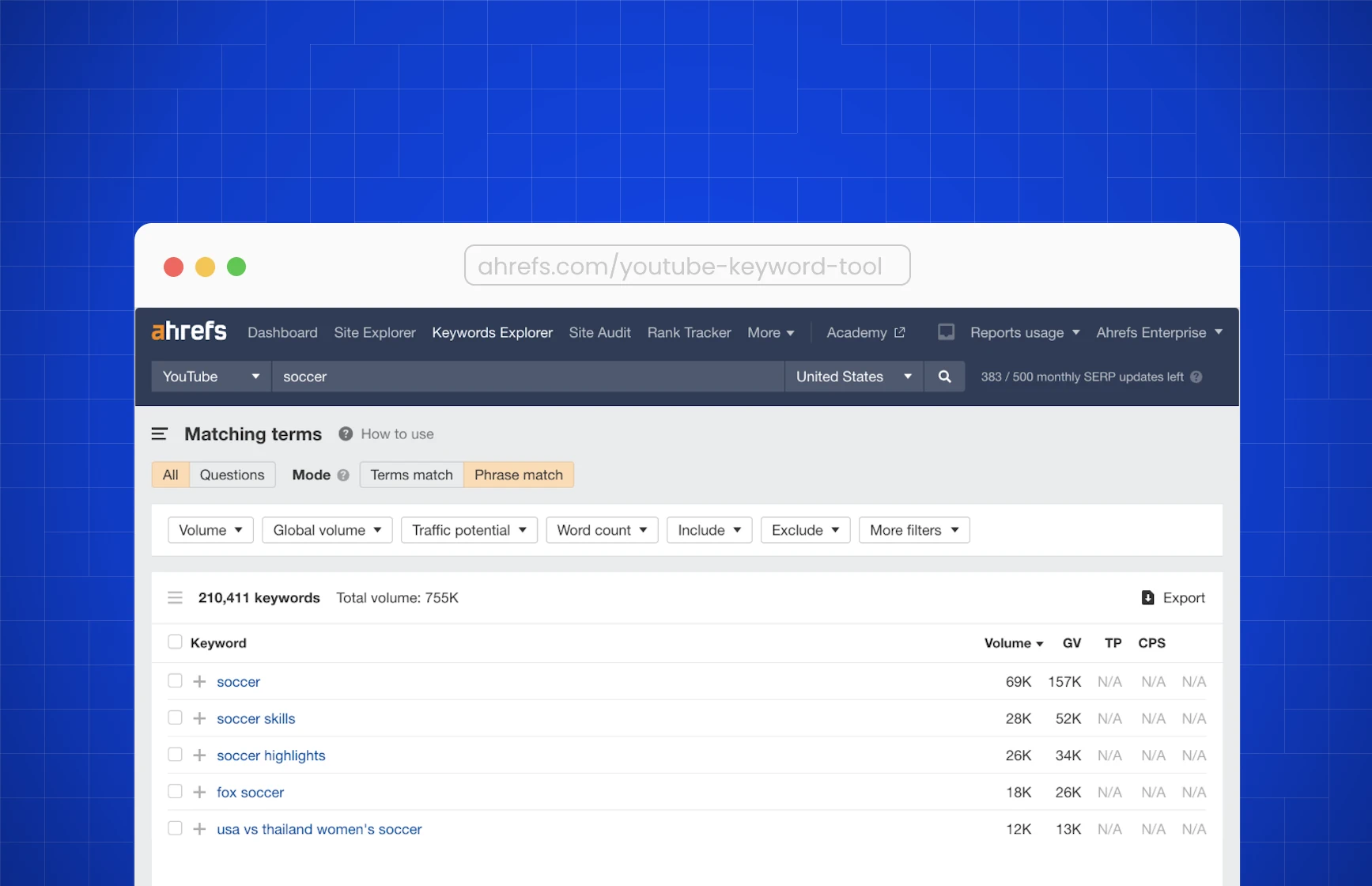
Keyword ideas are the strongest part
A creator often starts with a concept that is too broad to become a useful video promise. A seed such as “home coffee” can contain tutorials, equipment reviews, recipes, comparisons, and troubleshooting questions. Keyword expansion reveals the language viewers use inside that topic. This is where Ahrefs provides immediate value.
The list can also expose a mismatch between the phrase a creator planned to use and the phrase viewers understand. That does not mean the highest-volume wording should automatically become the title. It means the creator has a better vocabulary for checking the actual results and shaping the promise.
Country-level demand is useful for localized channels
Demand differs by language and market. A phrase that looks attractive in the United States may be less relevant in the country where most of a channel's audience lives. Ahrefs lets users change the country rather than relying on one global figure. That is a practical advantage for localized tutorials, education channels, reviews, and products with regional availability.
The data is best treated comparatively
Ahrefs describes its YouTube volume as an estimate derived from processed clickstream data. That is more useful than pretending every query has an exact, publicly available count. It also defines the correct way to use the number: compare relative demand across closely related ideas, then inspect YouTube itself before deciding what to make.
A volume estimate of 5,000 is not a promise of 5,000 available views. Some searchers will choose established videos, some will abandon the search, and some demand may be seasonal. The useful conclusion is that one query appears larger or smaller than another under the same methodology.
What Ahrefs does not answer for a YouTube creator
The main weakness is not bad keyword data. It is the distance between a keyword metric and a complete content decision. YouTube creators compete with videos, channels, thumbnails, formats, and viewer expectations. A query is only the entry point.
Volume does not reveal whether the result page is winnable
Two keywords can show similar estimated demand and still represent very different opportunities. One result page may be controlled by authoritative channels with polished, frequently updated videos. Another may contain old uploads, weak titles, inconsistent answers, or small channels that have recently broken through.
The free Ahrefs generator does not make that distinction its central job. Before recording, open the YouTube results and check channel size, video age, view distribution, freshness, format, and whether the leading videos satisfy the same intent you plan to target. KeywordsRocket's keyword competition signal is designed to make this comparison faster, but it should still support judgment rather than replace it.
A keyword does not prove channel fit
A large query can be strategically poor for a specific creator. The audience may expect credentials the channel does not have, a production format it cannot sustain, or follow-up topics that do not fit the channel. Conversely, a smaller query can become valuable when it sits inside a cluster the creator can cover repeatedly.
This is why niche and competitor research matter. A useful topic should connect to a wider market, recognizable viewer needs, and a credible publishing path. KeywordsRocket's YouTube niche finder helps evaluate market demand, competition, channel activity, and revenue potential around the idea instead of treating the keyword as an isolated win.
Search demand misses browse and suggested opportunities
Some successful YouTube ideas are searched directly. Others spread because the packaging earns clicks on Home or because the topic connects naturally to videos viewers already watch. Keyword tools are strongest for explicit demand. They are weaker when the opportunity is an emerging format, a surprising angle, or a proven concept that viewers did not know how to search for.
Outlier research fills part of that gap. A YouTube outlier finder identifies videos performing far above a channel's baseline, which can reveal formats and promises that keyword volume alone would miss. The combination is more reliable: keyword data for explicit demand, outliers for demonstrated viewer response.
It does not turn the idea into a differentiated brief
Finding “how to clean an espresso machine” is not the same as planning the strongest video for that query. The creator still needs to inspect what current videos cover, where viewers remain confused, which examples are missing, and what title and thumbnail promise can be both accurate and distinct.
A practical brief should record the main intent, common subquestions, current leaders, weak spots in existing coverage, the channel's relevant experience, and the clearest achievable promise. Without that layer, keyword research often produces titles that resemble every existing result.
How accurate is Ahrefs YouTube search volume?
The honest answer is that it is an estimate, not an official YouTube count. Ahrefs says it processes large amounts of clickstream data to estimate YouTube search volume. The company presents this as an advantage over tools that repurpose Google Keyword Planner figures. That claim supports using Ahrefs as a serious directional input, but it does not turn the number into first-party YouTube Analytics.
Creators can protect themselves from false precision with four checks:
- Compare related phrases under the same settings. Relative differences are usually more actionable than the exact number.
- Check the selected country. A market mismatch can make a valid estimate irrelevant to your audience.
- Inspect freshness. Fast-moving topics can change before a third-party dataset fully reflects the shift.
- Validate the YouTube results. Strong demand has little value if the intent, competition, or format does not fit your channel.
The same caution applies to every third-party YouTube keyword platform, including KeywordsRocket. Estimated search volume and competition are comparable research signals, not guarantees of ranking or views.
A better way to use Ahrefs for a real video decision
The most effective workflow does not ask one tool to provide every answer. It moves from language, to demand, to competition, to channel fit, then to packaging.
1. Expand one concrete seed topic
Start with a subject your channel can genuinely cover. Enter it into the Ahrefs YouTube Keyword Tool and collect the most relevant phrases, questions, and modifiers. Ignore ideas that only look attractive because of volume but do not match the audience you already serve.
2. Group ideas by intent, not by shared words
“Best espresso machine,” “espresso machine under $500,” and “how to use an espresso machine” share a product but represent different viewers and video formats. Separate comparisons, tutorials, troubleshooting, reviews, and inspiration. One video should usually own one clear intent.
3. Compare demand without treating it as certainty
Use Ahrefs to identify meaningful demand differences. A phrase with much stronger estimated volume deserves inspection, but do not discard a smaller long-tail query if the intent is clearer or the competition is visibly weaker.
4. Validate the live result set
Search each finalist on YouTube. Record the leading video formats, publication dates, channel sizes, views, title patterns, and unresolved questions. If every result answers a different intent, the keyword may be ambiguous. If recent small channels are winning, the opportunity may be more accessible than raw volume suggests.
5. Check the wider channel opportunity
Use competitor analysis to see whether relevant channels repeatedly win with this subject or only have one accidental hit. Then check adjacent keywords and related outliers. The aim is to distinguish a single searchable phrase from a repeatable content area.
6. Write a brief that explains why this video should exist
The final brief should contain more than a keyword. Define the viewer's situation, the decision or problem they need solved, the missing value in current results, the evidence or experience your video can add, and the title-thumbnail promise. If you cannot state the content gap in one sentence, more research is needed.
Ahrefs vs KeywordsRocket for YouTube keyword research
Ahrefs and KeywordsRocket overlap at keyword discovery, but they begin from different product contexts. Ahrefs is a broad SEO and marketing platform with a useful YouTube-specific generator. KeywordsRocket is built around YouTube research decisions.
That difference changes what happens after the first keyword appears. In Ahrefs, the natural next step is deeper keyword exploration and organization. In KeywordsRocket, the next step can be checking matching terms, related queries, viewer questions, current competition, the surrounding niche, competing channels, or outlier videos.
| Choose Ahrefs when... | Choose KeywordsRocket when... |
|---|---|
| You need a quick free demand check. | You need demand and YouTube-result competition together. |
| You already use Ahrefs for broader SEO work. | You want one workflow focused on YouTube creators. |
| Your task ends with a keyword list. | Your task continues into niches, competitors, channels, and outliers. |
| You mainly publish search-led tutorials or reviews. | You balance search topics with browse, suggested, and breakout research. |
| You are comfortable validating YouTube competition manually. | You want structured signals before inspecting the final result set. |
Neither choice needs to be absolute. Existing Ahrefs users can keep it for broad SEO research and use KeywordsRocket for the YouTube-native questions Ahrefs does not prioritize. A creator who only performs occasional keyword checks may find the free Ahrefs tool sufficient.
Four mistakes that make any YouTube keyword tool less useful
Choosing the largest keyword automatically
The largest query often has the broadest intent and strongest competition. A focused phrase with a clear viewer problem can be a better match for a smaller channel, particularly when the creator can produce the most complete answer.
Copying a keyword into the title unchanged
A title must communicate a compelling and accurate promise, not merely repeat a database row. Keep the central language recognizable, then make the outcome, constraint, or point of difference clear.
Ignoring the videos behind the metric
Volume and difficulty summaries compress a changing result page. Always inspect the current leaders. Their age, channel size, format, and coverage determine what competition actually means.
Building isolated videos instead of a topic system
A promising keyword becomes more valuable when it connects to follow-up videos, audience needs, and a recognizable channel position. Before recording, identify at least three credible adjacent topics. If none exist, the idea may attract traffic without strengthening the channel.
Final recommendation
The Ahrefs YouTube Keyword Tool is worth using. It provides a fast, credible way to expand a seed topic and compare estimated demand across YouTube queries and countries. Claims that Ahrefs has no current YouTube keyword tool are outdated as of July 22, 2026: Ahrefs maintains an active official tool page and continues to describe YouTube-specific keyword research.
Its output should be the start of the decision. A creator still needs to understand competition, channel fit, the current result set, adjacent topics, and the reason a new video deserves attention. If those questions matter every week, KeywordsRocket provides a more YouTube-native path from keyword discovery into market, competitor, and content research.
Start with the simplest test: use Ahrefs to find the language and approximate demand, then validate the same topic against real YouTube results. If the manual gap between those steps becomes the slowest part of your workflow, move to a platform designed to connect them.
Frequently asked questions
Does Ahrefs have a YouTube keyword tool?
Yes. Ahrefs currently provides a dedicated YouTube Keyword Tool that generates keyword ideas and monthly search-volume estimates for more than 170 countries. Ahrefs also describes deeper YouTube research through Keywords Explorer.
Is the Ahrefs YouTube Keyword Tool free?
Ahrefs offers a free browser-based YouTube keyword generator. Larger idea sets, advanced reports, saved lists, and other platform features may require an Ahrefs plan. Check the current Ahrefs pricing and feature pages before subscribing because packages can change.
Is Ahrefs YouTube search volume accurate?
It is a third-party estimate, not an exact YouTube count. Ahrefs says it processes clickstream data to calculate the metric. Use it to compare related queries, then verify country, intent, competition, and freshness before choosing a video.
Can Ahrefs find low-competition YouTube keywords?
Ahrefs can help you discover long-tail and question-based ideas, but creators should inspect the live YouTube results before calling a query low competition. Channel authority, video age, format, and result quality all influence the real opportunity.
What is the best Ahrefs alternative for YouTube creators?
KeywordsRocket is a strong alternative when you want YouTube keyword demand, competition, matching terms, related queries, niche analysis, competitor research, and outlier discovery in one workflow. Ahrefs is still a good choice for a quick free keyword check or for marketers already using its broader SEO platform.
Can I use Ahrefs and KeywordsRocket together?
Yes. Ahrefs can support broad SEO and initial keyword expansion, while KeywordsRocket can handle YouTube-native validation around competition, channels, niches, and outlier videos. The overlap is useful when you want to compare estimates rather than trust one metric blindly.
Sources checked for this review
- Ahrefs YouTube Keyword Tool, checked July 22, 2026.
- Ahrefs Free Keyword Generator, checked July 22, 2026.
- Ahrefs Keywords Explorer, checked July 22, 2026.
- Ahrefs pricing, checked July 22, 2026.
- KeywordsRocket YouTube Keyword Tool, checked July 22, 2026.